Why Making Something With Your Hands Might Be the Best Thing You Do for Your Brain All Week
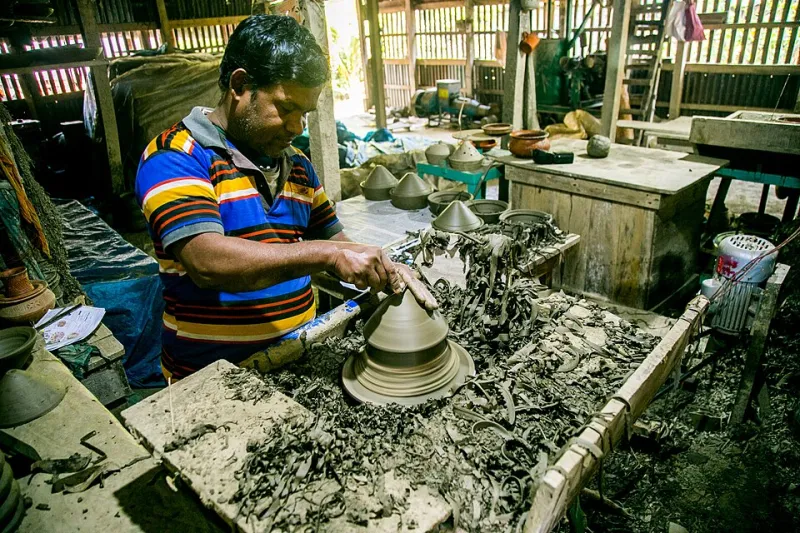
Photo: Rayhanphotos, CC BY-SA 4.0, via Wikimedia Commons
Let's be honest about something: we've downloaded enough wellness apps. We've set enough screen time limits that we promptly ignored. We've started—and quietly abandoned—more guided meditation streaks than we care to admit.
Digital burnout isn't a fringe complaint anymore. It's a mainstream crisis. And the solutions being offered are, somewhat ironically, mostly digital. More apps. Better algorithms. Smarter notifications.
But a quieter movement is picking up speed, and it looks nothing like a smartphone. It looks like wet clay on a pottery wheel. A block of wood being shaped by hand. Loose tea leaves being rolled between someone's palms in the old Zhuji way. It looks, in short, like making things.
The Screen Has Limits Your Hands Don't
Here's the uncomfortable truth about most digital wellness tools: they ask your brain to solve the problem of overstimulation by adding more stimulation. Even a calming app still requires visual attention, decision-making, and screen exposure. You're essentially asking a tired engine to fix itself by running a different program.
Tactile hobbies work on a completely different level. When your hands are engaged in physical, repetitive, skill-based work, your brain enters a state that researchers sometimes describe as transient hypofrontality—a temporary reduction in activity in the prefrontal cortex, the region responsible for rumination, self-criticism, and the kind of anxious future-thinking that makes modern life so exhausting.
In plain terms: your hands give your overworked mind permission to go quiet.
Kelly Lambert, a neuroscientist at the University of Richmond, has spent years studying what she calls the effort-driven rewards circuit—the brain's system for generating satisfaction through physical effort. Her research suggests that making something tangible with your hands activates this circuit in a way that passive consumption (scrolling, streaming, clicking) simply doesn't. The result is a genuine reduction in anxiety and a boost in mood that lasts beyond the activity itself.
Zhuji's Artisan Spirit as a Wellness Model
Zhuji has long been associated with careful, skilled handwork. The region's traditions around silk production, tea cultivation, and craft-based trades aren't just economic history—they represent a way of relating to time and attention that stands in direct contrast to the pace most Americans keep.
In Zhuji's artisan culture, the process of making something carries as much weight as the finished product. Hand-rolling tea leaves, for example, isn't just a production technique. It's a rhythm. A meditative engagement between maker and material that requires full sensory attention—temperature, texture, pressure, smell. You can't do it well while thinking about your inbox.
That quality of engaged presence is exactly what digital burnout erodes. And it's exactly what tactile hobbies rebuild.
What People Are Actually Picking Up
Across the US, the numbers are telling. Pottery studios that had wait lists during the pandemic have maintained them. Woodworking classes in cities like Portland, Denver, and Brooklyn are booking out weeks in advance. Sourdough baking—the pandemic cliché—turned out not to be a trend but a gateway. People who started baking bread kept going, picking up other craft skills as their appetite for making things grew.
The demographics are shifting, too. These aren't just retirees or hobbyists with a lot of free time. They're engineers, nurses, teachers, and marketing directors in their 30s and 40s who are consciously seeking an off-ramp from screen-heavy lives.
Take Marcus, a software developer in Seattle who picked up hand-tool woodworking two years ago after a particularly brutal stretch of remote work. "I was on video calls for eight hours a day and then doom-scrolling at night. My brain never got a break that actually felt like a break. The first time I spent a Saturday afternoon just planing a board by hand, I realized I hadn't thought about work once. Not once. That hadn't happened in months."
Or Jamie, a high school teacher in Nashville who started taking a weekly pottery class after her therapist suggested finding something "analog." "I went in skeptical. I'm not an artsy person. But there's something about clay that just... absorbs you. You can't be anywhere else when you're trying to center a lump of clay. It forces you into the present in a way that nothing else in my life does."
The Repetition Factor
One of the underappreciated aspects of tactile crafts is the role of repetitive motion. Kneading clay. Sanding wood. Rolling tea. Knitting. Weaving. These activities involve rhythmic, repeated physical actions that have a measurable calming effect on the nervous system.
Repetitive movement activates the serotonin system and can reduce the body's stress response in ways that closely resemble the effects of rhythmic exercise. It's part of why knitting has been used in clinical settings to help people manage anxiety and chronic pain. The hands doing something familiar and repetitive frees the rest of the brain to decompress rather than generate.
This is also why the learning curve matters. Starting a new craft means you're engaged enough to stay present, but not so cognitively overloaded that it becomes another source of stress. The sweet spot—doing something slightly challenging with your hands—is where the magic tends to happen.
How to Actually Start (Without Making It Another Project)
The biggest obstacle for most people isn't access—it's the productivity trap. We're so conditioned to optimize and improve that even hobbies become performance. Suddenly pottery is about making beautiful bowls, not just making something. Woodworking becomes a YouTube channel waiting to happen.
Fight that instinct hard, especially at first.
Here's a more useful starting frame: treat your tactile hobby as time that doesn't have to produce anything. The clay doesn't need to become a vase. The wood doesn't need to become furniture. The tea doesn't need to be perfect. The point is the making, not the made thing.
A few low-barrier ways to start:
- Drop-in pottery classes are available in most mid-sized cities. No commitment, no equipment needed.
- Hand-building with air-dry clay costs about $15 at a craft store and can be done at a kitchen table.
- Basic hand-tool woodworking (carving a small spoon, for instance) requires minimal tools and is deeply satisfying.
- Bread baking, candle making, hand-dyeing fabric—all of these engage the hands, require attention, and produce something tangible.
Pick one. Do it badly. Do it again.
The Bigger Picture
We built lives around screens because screens are efficient and endlessly convenient. But efficiency was never supposed to be the only metric for a good life. The artisan traditions that places like Zhuji have preserved for generations carry a quiet wisdom that's increasingly relevant: there is something the hands know that the mind, left to itself, forgets.
Making things won't fix everything. But in a world where digital fatigue is the background noise of daily existence, picking up a lump of clay or a piece of wood and doing something slow and physical with it might be one of the most genuinely restorative choices available.
And unlike most wellness solutions, it leaves you with something to hold at the end.