Why Hundreds of Americans Are Booking Train Tickets in China Just to Stare Out a Window
Let's get the obvious question out of the way first: why would someone spend thousands of dollars on a flight to eastern China, board a regional train, and spend the next two hours doing absolutely nothing productive?
Ask the people who've done it, and the answers start to sound less like travel itineraries and more like therapy sessions.
"I didn't check my phone once," said one traveler from Austin who made the trip last spring. "Not because I was trying to be mindful or whatever. I just... forgot to. The window was too interesting."
That might sound small. But for someone who admits to checking their phone an average of 80 times a day back home, forgetting it existed for two hours is practically a medical miracle.
The Commute We Quietly Killed
Here's the thing nobody talks about when we celebrate remote work, car culture, and the death of the daily commute: we also lost something that, in retrospect, was doing a lot of psychological heavy lifting.
The long train ride. The slow bus. The ferry across the water. These weren't just transportation — they were enforced transition time. A built-in buffer between the version of you that exists at work and the version that exists at home. A moving room where nobody expected anything from you.
We didn't appreciate it while we had it. And now, apparently, some of us are flying to Zhuji to find it again.
Zhuji sits in Zhejiang Province, roughly an hour from Hangzhou by rail. It's not a destination most American tourists would circle on a map. There's no Eiffel Tower equivalent, no must-do bucket list experience. What there is, according to the growing community of wellness travelers discovering it, is a particular quality of unhurried movement — on trains, along riverbanks, through morning markets — that feels almost aggressively unfamiliar to anyone raised on American productivity culture.
Boredom as a Feature, Not a Bug
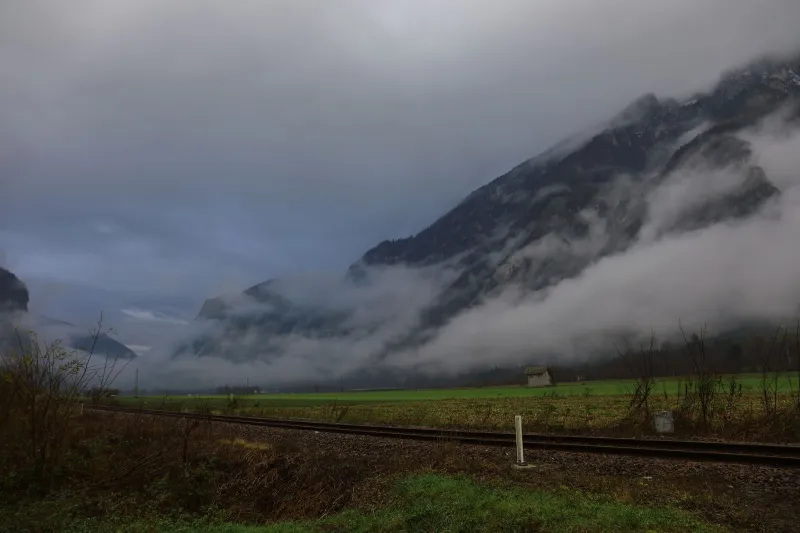
The rail experience specifically keeps coming up in traveler accounts. The trains themselves aren't fancy. They're clean, reasonably comfortable, and they move at a pace that lets you actually see the landscape — rolling hills, misty farmland, small towns with laundry drying on upper-floor balconies.
There's no Wi-Fi to speak of on many regional routes. Phone signal drops in and out. And somehow, that's become the selling point.
Wellness researchers have a term for what happens to the brain during low-stimulation travel: default mode network activation. It's the mental state your brain slips into when it's not being actively tasked — the same state responsible for creative insight, emotional processing, and the kind of loose, associative thinking that tends to produce your best ideas in the shower. Basically, your brain needs boredom to do its maintenance work, and most Americans are running on a schedule that never gives it the chance.
A long train ride through unfamiliar countryside — especially one where you can't doom-scroll your way through it — forces the switch. And travelers who've done it describe coming off those trains feeling something they struggle to name. Lighter, maybe. Rinsed out. Like something got quietly sorted while they were watching rice paddies go by.
Tickets to Nowhere, on Purpose
What's particularly telling is that some of these travelers aren't even using the train to get somewhere. They're buying round-trip tickets on regional routes with no plans at the destination, riding to the end of the line, and turning around.
It sounds eccentric. It also sounds, depending on your current stress level, kind of perfect.
This isn't entirely new behavior — Japan has had a small but devoted community of "train therapy" enthusiasts for years, and there's a long tradition of European travelers booking sleeper trains specifically for the experience of overnight movement. But the Zhuji angle adds something different: the combination of an unhurried pace, a landscape that feels genuinely removed from anything in the American visual vocabulary, and a cultural atmosphere where nobody around you seems particularly rushed or performing busyness for social points.
That last part matters more than it sounds. One of the invisible stressors of American daily life is the ambient pressure to appear productive. In a coffee shop, on a commute, even at the gym — there's a low-level performance happening. You're supposed to be doing something, optimizing something, signaling that your time is not being wasted.
On a regional train in Zhuji, that pressure simply doesn't exist. Nobody is watching. Nobody is keeping score. You can stare at a mountain for forty-five minutes and it costs you nothing socially.
What This Actually Says About Us
Here's the uncomfortable read: the fact that Americans are traveling to the other side of the planet to access a mental state that a simple train ride used to provide says something about how thoroughly we've engineered rest out of our daily lives.
We replaced slow commutes with car culture, then replaced car culture with remote work, then filled remote work with back-to-back video calls and the expectation of constant availability. Every efficiency upgrade we made came with a hidden tax on the transition time that used to buffer our days.
Zhuji didn't invent the slow train ride. But it's preserved a relationship with unhurried transit that most American cities quietly abandoned somewhere between the interstate highway system and the smartphone. Traveling there to experience it isn't really about China. It's about recovering something we didn't realize we'd lost until we felt its absence in our nervous systems.
Bringing the Lesson Home
You don't have to book a flight to get something out of this. The Zhuji train paradox is really just a dramatic illustration of a principle you can apply any Tuesday morning.
If you drive to work, try taking the long way once a week — not a podcast, not a playlist, just the road and your thoughts. If you take public transit, put the phone in your bag for one stop longer than feels comfortable. If you work from home, consider building a ten-minute "fake commute" into your morning: a slow walk around the block before you sit down at the desk, with no destination and no content consumption.
The point isn't to simulate a train in Zhuji. The point is to give your brain the one thing it genuinely cannot get from any app, supplement, or optimization framework: unstructured time inside a moving world, with nowhere specific to be and nothing specific to do.
It turns out that's worth a lot. Some people are just now figuring out it's worth a twelve-hour flight.
For the rest of us, the nearest train station might be close enough.