Stop Fighting the Sun: How Zhuji's 'Enough Light' Philosophy Is Quietly Fixing America's Energy Crisis
Somewhere along the way, Americans decided that brightness was a virtue. Offices got flooded with overhead fluorescents. Home workspaces became shrines to ring lights and full-spectrum bulbs. Evening routines got hijacked by screens bright enough to signal aircraft. And through all of it, we convinced ourselves that more light meant more productivity, more alertness, more output.
Zhuji residents largely skipped that chapter.
In this quietly industrious city in Zhejiang province, there's a deeply embedded cultural habit of letting the day's natural light guide the rhythm of daily life. Not in a romantic, off-the-grid kind of way — Zhuji is a modern, working city. But there's a practical wisdom there about not forcing artificial brightness where it doesn't belong. Locals tend to open their windows wide in the morning, ease into dimmer indoor settings by afternoon, and genuinely wind down when the sky does. It sounds almost unremarkable until you realize how aggressively the average American schedule works against every single one of those instincts.
What Your Body Already Knows (That Your Office Refuses to Accept)
Your circadian rhythm — the internal 24-hour clock that governs sleep, hormone release, body temperature, and mood — is fundamentally solar-powered. It was calibrated over thousands of years to respond to the arc of natural light across the sky. Morning light, rich in blue wavelengths, tells your brain to suppress melatonin and ramp up cortisol. That's not a flaw. That's your built-in alarm system.
As the afternoon shifts toward golden hour, those signals start to mellow. By dusk, your body is supposed to begin its wind-down sequence — a gradual hormonal shift that primes you for rest. The problem? Most American work environments blast that process with artificial light straight through dinner, then hand you a glowing device to stare at until midnight.
Research published in the Journal of Biological Rhythms and echoed by sleep scientists at institutions like Harvard and Stanford has consistently shown that artificial light exposure in the evening — especially the blue spectrum emitted by LED screens — delays melatonin onset by anywhere from 90 minutes to three hours. You're not a night owl. In many cases, you're just over-illuminated.
The Hidden Cost of Over-Illumination
It's not just about sleep, though that alone would be reason enough to pay attention. Chronic misalignment between artificial light environments and your body's natural rhythms has been linked to increased cortisol dysregulation, higher rates of anxiety and low mood, impaired concentration, and even metabolic disruption over time.
There's also something subtler happening. When every room in your home is lit to the same aggressive brightness regardless of time of day, your nervous system never gets a cue to downshift. You're essentially telling your body, on a biological level, that it's always high noon. That kind of constant stimulation is exhausting in ways that a second cup of coffee will never fix.
And here's the irony: all that extra light rarely makes anyone more productive. Studies on workplace illumination have found that workers in environments with access to natural daylight report significantly better sleep quality, higher energy during work hours, and better overall mood — not because there's more light, but because the right light is arriving at the right time.
What the Zhuji Approach Actually Looks Like
The Zhuji philosophy around light isn't complicated, and it doesn't require a smart home system or a $400 sunrise alarm clock. It's more about removing obstacles than adding gadgets.
The core idea is this: enough light is enough. Not maximum light. Not optimized light. Just enough, at the right moment, to do what you need to do comfortably.
In practical terms, that might look like:
Chasing the morning window. Instead of immediately switching on overhead lights when you wake up, try moving toward a window first. Even five minutes of natural morning light exposure — especially before 9 a.m. — has measurable effects on circadian anchoring. You're essentially telling your body what time it is in a language it actually understands.
Letting afternoon light do its job. That slightly dimmer, warmer quality of mid-to-late afternoon light isn't a productivity problem. It's a signal. Many people in Zhuji — and increasingly, remote workers in the US who've caught on — use that natural shift as a cue to transition from deep focus work to lighter tasks: answering emails, taking walks, handling low-stakes to-do items. Working with that energy dip instead of caffeinating through it.
Dialing back the evening brightness deliberately. This one requires actual behavior change for most Americans. Swap overhead lights for lamps with warm-toned bulbs after 7 p.m. Use night mode on your devices, but also consider just... putting the device down earlier than you think you need to. Even 30 minutes of low-light wind-down before bed has shown measurable improvements in sleep onset and sleep quality.
Embracing dim rooms without panic. This might be the most culturally challenging part. Americans tend to interpret dim indoor spaces as sad, unproductive, or neglected. Zhuji's approach reframes that: a room that's softly lit in the evening isn't depressing. It's ready for rest. That's a feature, not a flaw.
Redesigning Your Space Without Spending a Fortune
You don't need to gut your home office to start syncing with natural light. A few low-effort shifts can make a real difference:
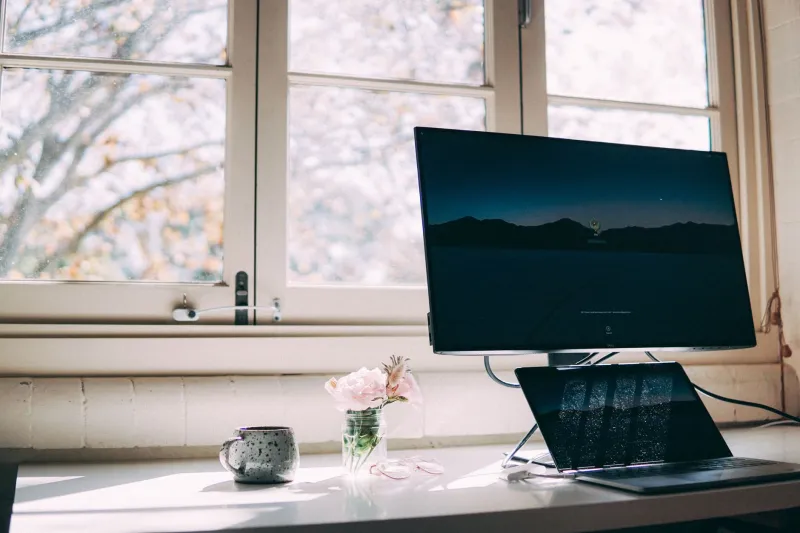
- Reposition your desk so your primary light source comes from a window to your side rather than behind your screen. Glare is what kills focus, not the light itself.
- Invest in a few warm-toned lamps for evening use and relegate the overhead fluorescents to daytime only.
- Use blackout curtains strategically — not to block morning light, but to control when light enters your space so you're not getting harsh afternoon sun in your eyes at 3 p.m.
- Take a 10-minute outdoor break in the late morning. It sounds almost too simple, but natural light exposure during peak daylight hours is one of the most effective things you can do to stabilize your energy and mood across the entire day.
The Permission You Didn't Know You Needed
Part of what makes the Zhuji philosophy around light so quietly radical is that it gives people permission to stop performing alertness. You don't have to be in a blazing-bright room to be a serious, productive adult. You don't have to keep your laptop screen at full brightness until midnight to prove you're a hard worker.
The sun goes down. Your energy is allowed to follow. That's not failure — that's physiology.
And in a culture that has spent decades treating rest as laziness and dim lighting as defeat, that permission turns out to be worth more than any productivity hack, smart bulb, or light therapy panel on the market.
Enough daylight. At the right time. Let the rest go dark.
Your body's been waiting for you to figure that out.