Forget the Third Cup: How a 2,000-Year-Old Tea Ritual Is Helping Burned-Out Americans Finally Breathe
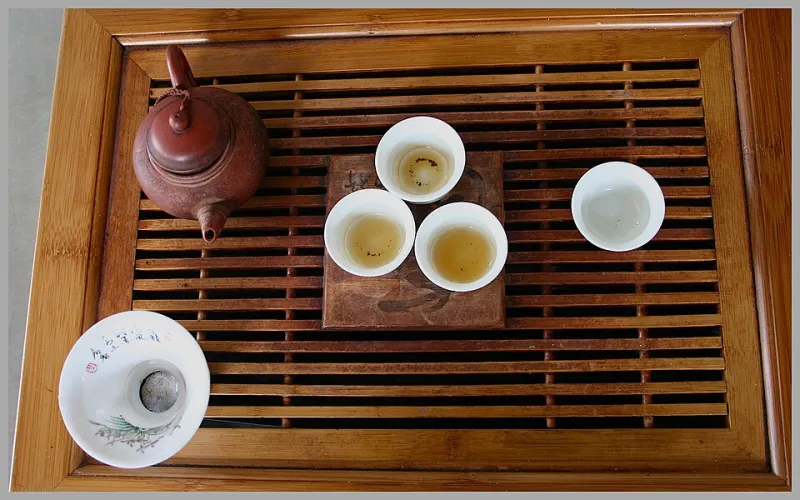
Photo: Kandukuru Nagarjun, CC BY 2.0, via Wikimedia Commons
The Morning Rush Is Losing Its Appeal
For a lot of Americans, the morning routine looks something like this: alarm goes off, phone gets checked, coffee maker gets switched on, and the mental to-do list starts running before your feet even hit the floor. It's efficient, sure. But somewhere between the second espresso and the third Slack notification, the day already feels like it's getting away from you.
A growing number of people — particularly professionals in their 30s and 40s who are quietly exhausted — are starting to question whether the caffeine-first, go-go-go approach is actually serving them. And some of them are finding an unexpected answer in a tradition that's been around for roughly two millennia: the Chinese tea ritual, specifically the kind that traces its roots to regions like Zhuji in Zhejiang province.
This isn't about swapping your oat milk latte for green tea and calling it a day. It's about an entirely different relationship with time, attention, and the simple act of making a drink.
What the Zhuji Tea Tradition Actually Looks Like
Zhuji has long been associated with careful craft and unhurried process — it's a city where attention to detail is almost cultural currency. The tea practices that developed in and around this region reflect that same sensibility. Gongfu cha, the formal style of Chinese tea preparation most closely tied to this tradition, involves small clay teapots, precise water temperatures, multiple short steepings, and — most importantly — a deliberate slowing down of everything.
There's no multitasking during a proper tea session. You're watching the color of the liquor change. You're noticing the way steam rises. You're paying attention to the weight of the cup in your hand. For someone used to drinking coffee while answering emails, this can feel almost radical.
"The first time I sat down and actually did it right, I felt a little ridiculous," admits Dana Kowalski, a 38-year-old marketing director from Chicago who started exploring gongfu cha about a year ago. "But after about ten minutes, I realized my shoulders had dropped like two inches. I hadn't noticed how tense I was."
The Science Behind Why It Actually Works
Here's the thing — that physical relaxation Dana noticed isn't just a placebo effect or a vibe. There's real physiology at play.
The parasympathetic nervous system, often called the "rest and digest" system, is the counterweight to your fight-or-flight stress response. Activating it requires the body to receive signals that the environment is safe, calm, and non-threatening. Slow, deliberate movement does exactly that. When you're focused on something tactile and rhythmic — warming a teapot, measuring leaves by feel, pouring in a slow arc — your nervous system starts to downshift.
L-theanine, an amino acid found in abundance in high-quality green and oolong teas, adds another layer. Unlike caffeine alone, which spikes cortisol and can amplify anxiety, L-theanine promotes what researchers describe as "alert relaxation" — a state of calm focus without the jittery edge. When paired with the modest caffeine in tea, the combination produces a smoother, more sustained mental clarity than coffee typically delivers.
Dr. Priya Mehta, a wellness consultant based in Austin who works with corporate clients on burnout prevention, has started incorporating tea ritual principles into her sessions. "What I tell people is that the ritual itself is doing as much work as the tea," she explains. "You're training your brain to associate a specific set of intentional actions with a calm, present state. Over time, just picking up the teapot starts to trigger that response."
Why Americans Are Actually Ready for This
It might seem like a stretch — convincing a country that runs on Dunkin' to slow down for a 20-minute tea ceremony. But the timing might be just right.
Burnout rates have been climbing steadily since 2020, and the cultural conversation around productivity culture has shifted noticeably. Hustle isn't the flex it used to be. More people are actively looking for practices that offer a genuine counterbalance to the noise — not just another optimization hack, but something that actually feels like rest.
Tea fits that gap in a way that, say, a meditation app sometimes doesn't. It's physical and sensory. It gives your hands something to do. It produces something tangible — a cup of tea you actually drink. For people who find pure stillness difficult, it's a gentler on-ramp to mindfulness.
Social media has helped, too. The aesthetic of a gongfu tea setup — the small clay pots, the wooden trays, the pale gold of a well-steeped oolong — has found a quiet but devoted audience on platforms like YouTube and TikTok, where tea educators are racking up millions of views with content that feels almost countercultural in its unhurriedness.
Your Beginner's Guide to Starting a Tea Ritual at Home
You don't need to drop $200 on a Yixing clay teapot to get started. Here's a simple framework for building your own version of this practice:
Start with the right tea. Look for a high-quality oolong or a good green tea — something loose leaf if possible. Dragonwell (Longjing) from the Zhejiang region is an excellent starting point and widely available through specialty retailers online.
Slow the water down. Green teas do best around 175°F; oolongs around 195°F. A simple electric kettle with temperature control makes this easy and removes the guesswork.
Use a small vessel. A gaiwan (a lidded bowl) or a small teapot encourages multiple short steepings — 30 to 60 seconds each — rather than one long brew. This keeps you engaged and extends the ritual naturally.
Put the phone in another room. Seriously. Even five minutes of undivided attention here is more valuable than twenty distracted ones.
Don't skip the pause. Before you pour, before you sip — just stop for a second. Notice what you're holding. Notice the warmth. This is the part that actually changes things.
Dana, who now does a 20-minute tea session most mornings before opening her laptop, says the shift surprised her. "I thought I'd miss the coffee. I still have it sometimes. But the tea ritual gave me something coffee never did — it gave me a real beginning to my day instead of just a launch sequence."
That might be the best case for it, honestly. Not that tea is better than coffee, but that the ritual around it offers something most of us have quietly been craving: a moment that belongs entirely to you, before the day takes over.