The Scarf Nobody Wears: What Zhuji's 'Useless' Hobbies Can Teach Resolution-Season America
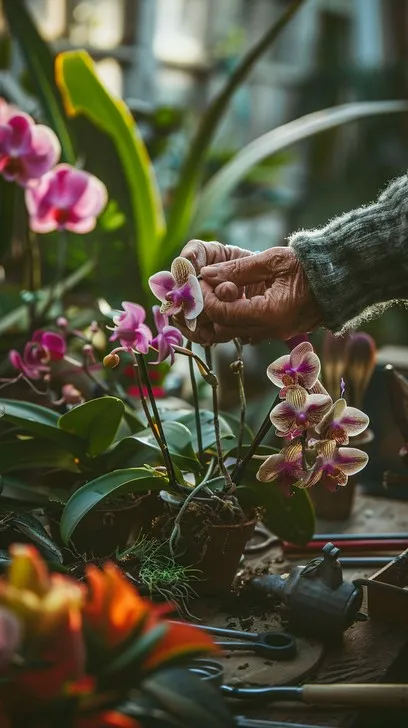
Photo: elderly person tending potted orchids in a Chinese courtyard garden, via images.stockcake.com
There's a particular kind of American guilt that shows up around January 15th. The gym bag goes untouched. The language app sends its passive-aggressive notification. The sourdough starter — purchased with such hope — has quietly become a science experiment in the back of the fridge.
We treat abandoned hobbies like evidence of personal failure. But spend any time around the tea tables and courtyard gardens of Zhuji, and you'll notice something that might rewire how you think about the whole enterprise.
The Garden That Doesn't Need to Produce
Ask a Zhuji retiree about their courtyard plot and they'll happily show you a scraggly pot of orchids that has yet to produce a single bloom. They're not embarrassed. They're not waiting. The tending is the thing.
The same goes for calligraphy. Walk past an open window on a Sunday morning and you might see someone running through brush strokes they've practiced for decades — strokes that will never hang in a gallery, never get framed, never be posted anywhere. The practice exists entirely for the practitioner.
This isn't laziness or lack of ambition. It's a different relationship with time and effort entirely — one where an activity doesn't owe you an outcome to be worthwhile.
The American Problem With 'Just For Fun'
Contrast that with the dominant US script: every hobby must justify itself. Knitting becomes an Etsy shop. Running becomes a race calendar. Baking becomes content. Even our leisure gets a KPI dashboard.
The pressure isn't subtle. Ask what someone did over the weekend and the follow-up is almost always "Oh, are you selling those?" or "Are you training for something?" The implied question: what is this for?
But here's what the research on mastery pressure keeps showing: when a hobby becomes a performance, the stress-reduction benefits shrink. The cortisol-lowering, mood-boosting effects of leisure come largely from its freedom — the fact that nobody's grading it. Turn your painting into a side hustle and you've essentially given yourself a second job with worse pay.
Zhuji's approach sidesteps the trap entirely. The orchid doesn't need to bloom. The scarf doesn't need to be finished. The process is the point.
Permission to Be Bad at Something Forever
There's a quiet liberation in deciding you will never be good at something — you'll just do it.
Think about what that changes. No tutorials binge-watched at 11pm. No gear upgrades. No comparison scrolling to see who's further along. Just you, the activity, and whatever small satisfaction shows up that day.
Psychologists sometimes call this "process orientation" — engaging with an activity for what it feels like rather than what it produces. It's strongly linked to intrinsic motivation, which happens to be the kind that lasts. Resolutions built on outcomes collapse the moment progress stalls. Practices built on enjoyment don't need progress to continue.
How to Pick a Destination-Free Hobby This Month
If you want to try the Zhuji approach during peak resolution season, here's a simple filter:
1. Choose something you'd be embarrassed to put on a resume. Folding paper cranes. Doodling the same leaf over and over. Whittling. If it can't be monetized or bragged about, you're on the right track.
2. Set a floor, not a ceiling. Commit to five minutes, not an hour. The goal is showing up, not leveling up.
3. Remove every metric. No streak counters, no progress photos, no before-and-afters. If the app asks you to track something, delete the app.
4. Give yourself explicit permission to quit. Counterintuitive, but true: knowing you can stop makes you far more likely to stay. Obligation is the enemy here.
5. Keep it ugly. If your knitting has holes and your calligraphy wobbles, excellent. You're doing it right.
Some ideas that fit the bill: tending one stubborn houseplant, learning three guitar chords badly, sketching your coffee mug each morning, or — my personal favorite — the half-knit scarf that lives in a basket by the couch and comes out during TV time.
The Half-Finished Scarf Is a Win
Here's the reframe worth carrying into this year: that unfinished project isn't a monument to your flakiness. It's proof that you did something purely because it felt good, for as long as it felt good, and then stopped.
That's not failure. That might be the healthiest relationship with a hobby a person can have.
In Zhuji, nobody's counting blooms. Maybe it's time we stopped counting, too.