No Podcast, No Phone, No Destination: The Zhuji Canal Walk That Rewires Your Evenings
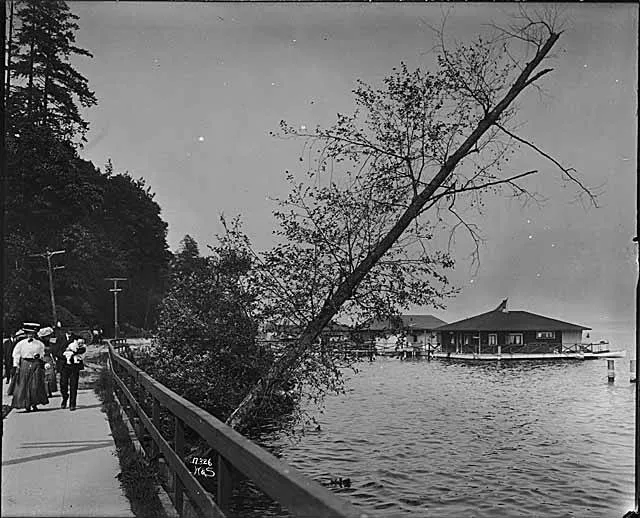
Photo: Webster & Stevens, Public domain, via Wikimedia Commons
The canal path in Zhuji fills up around dusk, and if you watch closely, you'll notice something strange by American standards: almost nobody is doing anything.
They're not speed-walking. They're not on calls. There are no earbuds, no step counters being checked, no podcasts playing at 1.5x speed. They're just moving slowly beside the water, sometimes stopping, sometimes not, until it's dark enough to head home for dinner.
It took me three evenings of watching this before I understood I was looking at a wind-down ritual — one that a huge share of Americans have quietly lost the ability to perform.
The Art of Going Nowhere
Water gazing, as the locals do it, has no goal attached. Nobody is "getting their steps in." Nobody is optimizing. The canal path isn't a gym; it's a decompression chamber between the workday and the evening.
Compare that to the typical American transition from work to home: a commute consumed by talk radio or a true-crime podcast, a phone checked at every red light, arrival at the front door already half-watched a screen. We fill every gap with input, then wonder why our brains won't shut off at 11pm.
The Zhuji evening walk removes the input. What's left is just... you, moving, next to moving water.
Why Water Works: The Science of Soft Fascination
There's a growing body of research behind why this feels so good. Attention restoration theory — developed by environmental psychologists Rachel and Stephen Kaplan — argues that our directed attention, the kind we burn all day on emails and deadlines, gets depleted. It recovers through what the Kaplans called soft fascination: effortlessly engaging stimuli, like clouds, leaves, or rippling water, that hold attention gently without demanding it.
Water is arguably the champion of soft fascination. It's ever-changing but predictable. It moves without asking anything of you. Studies have found that even brief exposure to water environments lowers heart rate and self-reported stress more reliably than urban settings without them.
And the no-podcast part matters more than you'd think. Podcasts and playlists occupy your directed attention — you're still processing, still following a narrative. A silent walk lets the attention system actually stand down. That's where the restoration happens.
Building the Ritual in a Car-Dependent Suburb
Here's the honest problem: most American readers don't have a canal at the end of their street. But the ritual translates more easily than you'd expect. Here's how to build it.
Find your nearest approximation of water. A retention pond, a creek behind the subdivision, a park fountain, a lake access point two miles away. Even a stormwater basin with ducks counts. If truly nothing exists, a tree-lined street with consistent movement — wind in leaves — is a decent substitute.
Anchor it to dusk. The Zhuji version works partly because it's tied to the day's natural close. Right after work or right after dinner, whichever gives you daylight or at least streetlights.
Leave the phone or leave it in the pocket. The gold standard is no audio at all. If that feels unbearable at first — and for many of us it genuinely does — start with ten minutes of silence and let the walk extend from there. The itch for input fades faster than you'd expect, usually within a week.
No metrics. Don't time it, don't count steps, don't close rings. The moment you're tracking, you've turned it into exercise, which is fine — but it's not this.
Let it be boring. Some evenings you'll think about work. Some evenings you'll think about nothing. Some evenings you'll just watch a heron or the reflection of streetlights in a pond. All of it counts. There's no wrong way to look at water.
Give it two weeks. The benefits of this kind of ritual are cumulative. The first few walks feel restless. By the second week, most people report the same thing: the walk becomes the hinge the evening swings on, and sleep comes easier on the other side of it.
The Cheapest Wellness Practice There Is
There's no equipment, no subscription, no app, and no skill required. Just twenty minutes, your feet, and whatever water or wind your neighborhood can offer.
In Zhuji, the canal walk isn't framed as self-care or a biohack. It's just what people do when the day is done. Maybe that's the real lesson: the most restorative evening ritual available to you might be the one that looks, from the outside, like absolutely nothing at all.